

Table of Contents
I once spent over 2,600 Connects a month on Upwork without getting a single job interview.
The worst part? I wasn’t new to Upwork. I’d been freelancing for years, had completed jobs, worked with different clients, and received good reviews. I had the experience and work history to show for it.
Yet, for some reason, the responses stopped coming.
I thought something was wrong with my proposals and my profile, so I started making changes. I changed my profile title, added more portfolio samples, rewrote my description, and even experimented with lowering my hourly rate. I kept thinking one of those changes would make a difference, but nothing seemed to work.
It got to the point where I started questioning whether Upwork was still worth the effort. I even began looking for other ways to find clients because I couldn’t keep spending money on applications without getting anything.
If you’ve been freelancing for a while, you probably understand the frustration. You’ve got the experience, completed jobs, and built a portfolio. You read job descriptions and write your own proposals, yet the applications that once brought you interviews now sit there without a response.
After years of freelancing, and having hired freelancers on Upwork myself, I’ve learned there’s more to consider before assuming something is wrong with your proposals or profile.
Before spending more Connects or changing anything else, here are seven things worth looking into:
- The client’s hiring history: Do they regularly award contracts, or do they keep posting jobs without hiring?
- The client’s hiring activity: Are they reviewing regular applications, inviting freelancers, or paying attention to both?
- The client behind the job post: Do they know what they want, or are they still trying to figure it out?
- The work you’re competing for: Are you applying for jobs that match your experience, and are clients still looking for the same skills?
- Your proposal: Is your approach still working, or have you been sending the same kind of application for years?
- Your profile and portfolio: Can clients easily find evidence that you’ve done the work they’re advertising?
- Your application results: Where are things going wrong, and what actually needs changing?
Let’s start with something you can check before writing a single sentence of your proposal.
1. Some Clients Post Jobs but Rarely Hire Anyone
One habit I’ve developed on Upwork is checking how often clients have hired freelancers before spending my Connects on their jobs.
Take a look at these four Upwork client histories.
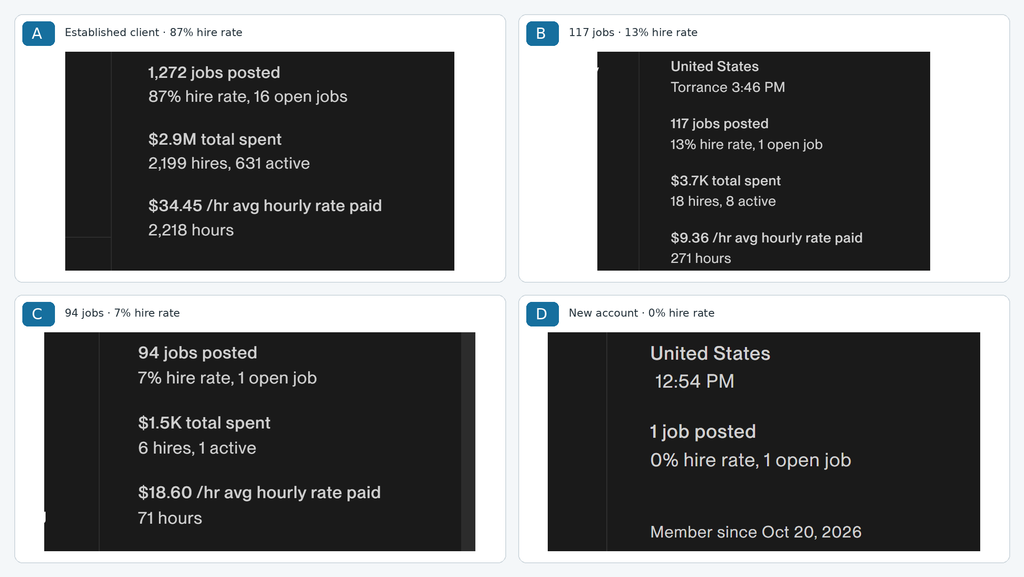
Client A has posted 1,272 jobs, with an 87% hire rate and approximately $2.9 million spent on Upwork. Compare that with Client B, who has posted 117 jobs but has a hire rate of just 13%.
Then there’s Client C, who has posted 94 jobs, with a 7% hire rate and approximately $1,500 spent. That’s the kind of hiring record that makes me think twice before applying.
Why Should You Care About These Numbers?
When I first started freelancing on Upwork, I had three friends who were also using the platform. We noticed one particular client, a woman who regularly posted jobs and sometimes even contacted us directly.
She would ask questions and interview us as though she was seriously considering hiring someone. All four of us had dealt with her, but none of those conversations resulted in a contract. She just kept posting jobs and never hired anyone.
Eventually, we recognized the pattern and became cautious whenever her listings appeared.
Of course, clients sometimes cancel projects, reconsider their budgets, or decide not to proceed. I’ve seen that happen. But if someone has been posting jobs for a long time and rarely hires anyone, it’s worth taking that history into account.
Now look at the fourth screenshot.
That client has posted only one job and has a 0% hire rate. Would you treat that client the same way as the one with 94 jobs and a 7% hire rate?
I wouldn’t. The fourth client is new and hasn’t had much opportunity to build a hiring record. I’d look more closely at the job description and other available details before deciding whether to apply.
Having no previous hires on your first job posting is quite different from having a 7% hire rate after posting dozens of jobs.
And while you’re checking the client’s history, look at what they’ve paid other freelancers. If your rate is $35 an hour but the client has consistently paid much less, check whether the current budget makes sense for the work you’re offering.
2. Is the Client Paying Attention to Regular Applicants?
Some clients post a job and immediately start reaching out by invitations to freelancers they’ve already found. Others review the applications they receive alongside the people they’ve invited.
I’ve seen both behaviors, and if you’re applying without an invitation, it’s worth knowing what the client is doing.
Here’s another job I came across.
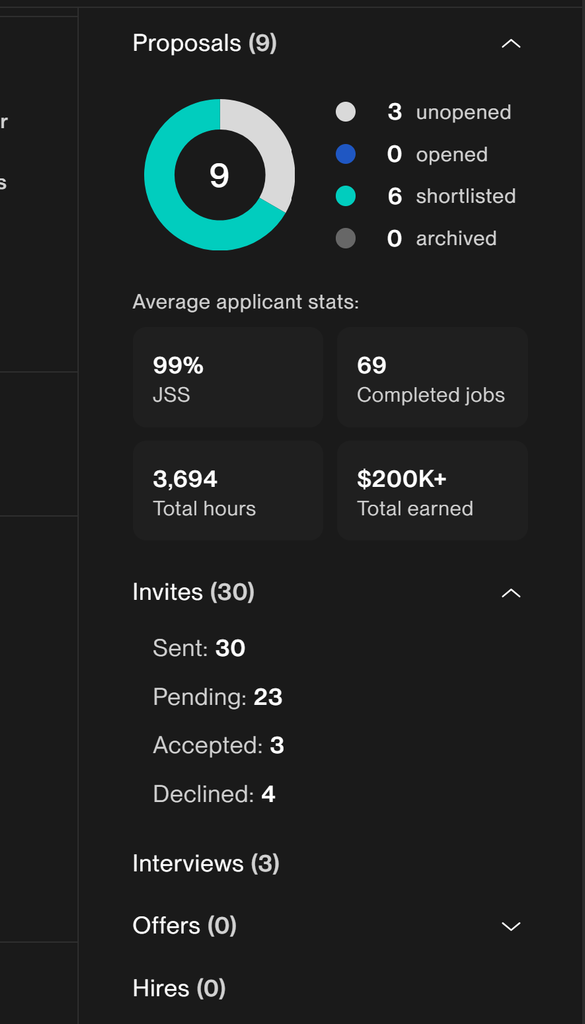
The client had sent 30 invitations. At the time of the screenshot, 23 were pending, three had been accepted, and four had been declined.
There were also nine regular proposals, six of which had been shortlisted. Three interviews were underway, and no hire had been recorded yet.
What Does That Tell You Before Applying?
For one thing, the client wasn’t completely ignoring regular applicants. Six had already been shortlisted, although we can’t tell from the screenshot whether the three interviewees came through invitations or regular applications.
But the client was also actively approaching freelancers rather than waiting for people to apply.
Now, suppose you have some experience with the assignment, but nothing particularly strong to separate you from the other candidates. Would you spend additional Connects boosting your proposal when the client is already considering several people?
I’d think carefully about that.
However, if I’d completed closely related projects and had solid work to show, I might still apply.
That’s why I don’t automatically avoid jobs with 40 or 50 applicants. I’ve received responses on competitive listings myself. Sometimes a job with four applicants isn’t nearly as promising as one with 40.
3. Read the Client Before Writing Your Proposal
Not all clients are the same. I’ve dealt with very busy clients who just want someone capable of doing the work so they can agree on the project and move on.
I’ve also dealt with clients who take their time comparing applicants, checking portfolios, and asking questions before making a decision.
Some write short but specific job descriptions because they already know exactly what they’re looking for. They don’t necessarily want to spend half their day reading proposals. Show them you’ve handled similar work, address what they’re asking for, and get to the point.
Others write long, detailed descriptions and expect applicants to read them properly. If they’ve provided specific requirements, a few generic sentences won’t tell them much about your ability to handle the assignment.
And then there are clients whose descriptions are so vague that you can tell they haven’t fully worked out what they need.
After dealing with different kinds of clients over the years, I’ve learned not to approach everyone the same way. Read the description, consider how the client is hiring, and work out what they’d need to see from you before writing your proposal.
4. Are You Still Competing in the Right Area?
When I first started on Upwork, I already had experience writing blog posts, technical content, and YouTube scripts.
But I decided to focus on YouTube scriptwriting.
Why? I thought general blog writing was more competitive, especially for someone without an established work history on Upwork. YouTube scripting was something I knew well, and I believed I had a better chance of getting established there.
That didn’t mean the jobs came easily.
I spent Connects during my first few months, had interviews that went nowhere, and eventually started picking up smaller contracts. As I completed more projects and received good reviews, I branched out into other types of writing work I’d already been doing for years.
I didn’t suddenly learn blog writing after getting those contracts. It was a skill I already had. I’d simply chosen where I wanted to compete first.
Check Whether the Market Has Changed
If you’ve been offering the same service for years but aren’t getting the responses you used to, look at the jobs clients are posting now.
Are there fewer jobs that match your experience? Are clients asking for skills they didn’t previously require? Has the work become more specialized?
For example, you might have years of experience managing social media accounts, but many of the jobs you’re now applying for also require paid advertising, analytics, and campaign reporting.
If you haven’t handled those responsibilities, the problem isn’t necessarily your proposal. You’re applying for work that’s different from what you previously did.
5. Maybe Your Proposal Isn’t Doing Enough Anymore
I’ve applied to jobs with more than 20 proposals and still received responses.
One particular job involved improving existing website content for SEO and AI search visibility.
I could’ve sent the usual proposal explaining how I’d improve readability, create engaging content, and optimize the articles for search engines. Instead, I focused on something I’d noticed from doing that kind of editorial work.
This was the observation I included in my application:
Improving existing content isn’t necessarily about adding more words. Sometimes the work is identifying material that adds nothing and is disrupting the article’s rhythm.
When the client responded, they specifically mentioned that point.
What Worked Before Might Need Changing
I don’t write proposals exactly the way I did when I first joined Upwork. Some approaches I used successfully in earlier years aren’t necessarily what I use today. If you’ve been relying on the same format for years, go back and read a few of your older proposals that actually got responses. Then compare them with what you’re sending now.
Are you still saying something useful about the assignment, or have your applications become the same greeting, followed by your credentials and a few promises?
If you’re using AI to help write proposals, it’s worth checking whether the wording still sounds like you. I’ve also looked at which AI writing tools produce more natural content and where they tend to fall short.
There’s no need to come up with a new proposal formula every month. But I wouldn’t keep using something just because it worked three years ago.
6. Does Your Profile Match the Job You’re Applying For?
I learned something about this when I started hiring freelancers on Upwork.
I once posted a job for a technical writer and received around 20 applications within two hours. When I checked again later, there were roughly 40.
One applicant caught my attention because he’d asked some thoughtful questions about the assignment in the opening paragraph of his proposal. I liked his approach, so I opened his profile.
His headline said he was a full-stack developer.
He had a good profile, positive reviews, and experience as a developer. But I was looking specifically for someone with a technical writing background, and I couldn’t find enough evidence that he’d done the kind of writing I needed.
Despite his thoughtful proposal and good reviews, I didn’t hire him.
Show the Experience the Client Wants to See
What if he’d included an API guide, software manual, or technical tutorial he’d written? At least I would’ve had something relevant to examine.
This matters even more when you offer different services.
You might have years of experience writing technical documentation, but if your profile mainly shows general blog posts, how easily can a client looking for a technical writer see that you’ve handled similar work?
Sometimes you don’t need to rewrite your entire profile. You just need to bring the right samples forward, describe your previous work more clearly, or make the relevant experience easier to find.
7. Don’t Change Everything Because Your Results Have Declined
One of the most frustrating things about not getting jobs on Upwork anymore was that I couldn’t figure out why the interviews had stopped.
And because I’d changed several things at once, I couldn’t tell whether any particular adjustment was helping.
Start With What’s Not Working
So how do you figure out where the problem is? Before changing your profile again, take a look at what has happened with your recent applications.
Suppose you’ve submitted 25 proposals, but only two were viewed. I’d examine the clients and jobs first. Were those clients actively hiring? How many other freelancers were competing? And did the assignments really match your experience?
Now suppose 18 of those 25 proposals were viewed, but nobody contacted you.
That’s a different situation. Clients are opening your applications, so I’d look more closely at what they see when they open them, including your proposal and relevant work samples.
You can also compare your recent results with an earlier period when you were getting interviews. That gives you something more useful to work with than the frustration of another unsuccessful week.
I’d rather change one thing, see how it performs, and learn from that before making another change.
Keep Applying, but Don’t Watch Every Proposal
Freelancing has its good periods and its difficult ones. I’ve experienced both.
I’ve also noticed that opportunities don’t come at the same pace throughout the year. Businesses plan projects, review budgets, prepare campaigns, and decide when to invest at different times.
For content writers, a new business planning cycle can bring website updates, editorial projects, and marketing campaigns. Other freelancers experience similar changes depending on their services and the industries they work with.
When suitable jobs are available, I apply consistently. Some days I might submit five applications, while other days it could be ten or fifteen. It depends on what’s available, and I don’t apply simply to reach a particular number.
There’s also a habit I’ve managed to break.
I used to spend a lot of time checking whether clients had viewed my proposals. If I saw that someone had opened an application, I’d start expecting a message. When nothing came, I’d check again later, hoping something had changed.
Sometimes this went on for days, and it became discouraging. I found myself thinking more about the proposals that hadn’t received responses than the jobs I could still apply for.
These days, I submit my applications and move on to something else. I still check messages and review how my applications are performing, but I don’t spend the whole day watching proposal statuses.
That approach has worked better for me.
Have you ever gone through a period when Upwork suddenly stopped bringing you interviews, even though you’d been getting hired before? What did you change, and did it help?
I’d like to hear about your experience in the comments.